
Description
Ponatinib can cause fatal and life-threatening arterial occlusion events (heart attack, stroke, vision loss, and limb amputation), sometimes within 2 weeks of starting treatment. In clinical trials, arterial occlusive events occurred in approximately 33% of patients. Venous thromboembolism, heart failure, and serious liver toxicity have also occurred. Close cardiovascular monitoring throughout treatment is mandatory, not optional.
Is Ponaxen right for your situation?
Review these criteria with your haematologist before enquiring- ✓Chronic, accelerated, or blast phase CML, or Ph+ ALL, for whom no other TKI therapy is indicated
- ✓T315I-positive CML or T315I-positive Ph+ ALL (the mutation most other TKIs cannot overcome)
- ✓Resistant to or intolerant of at least 2 prior kinase inhibitors
- ✓Need a WHO-GMP generic alternative to Iclusig® (Takeda)
- ✗Significant uncontrolled cardiovascular disease or history of arterial occlusive events
- ✗Uncontrolled hypertension
- ✗Pregnant, planning pregnancy, or breastfeeding
- ✗Alternative, lower-risk TKI options have not yet been tried, where clinically appropriate
Check Availability & Pricing
Prescription required · Named Patient Program · Worldwide shipping
🛡 WHO-GMP Certified · Prescription verified · Express dispatch
What is Ponaxen?
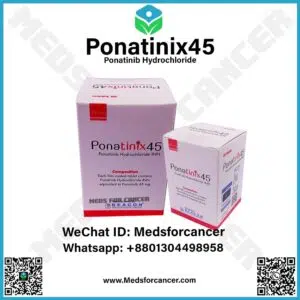
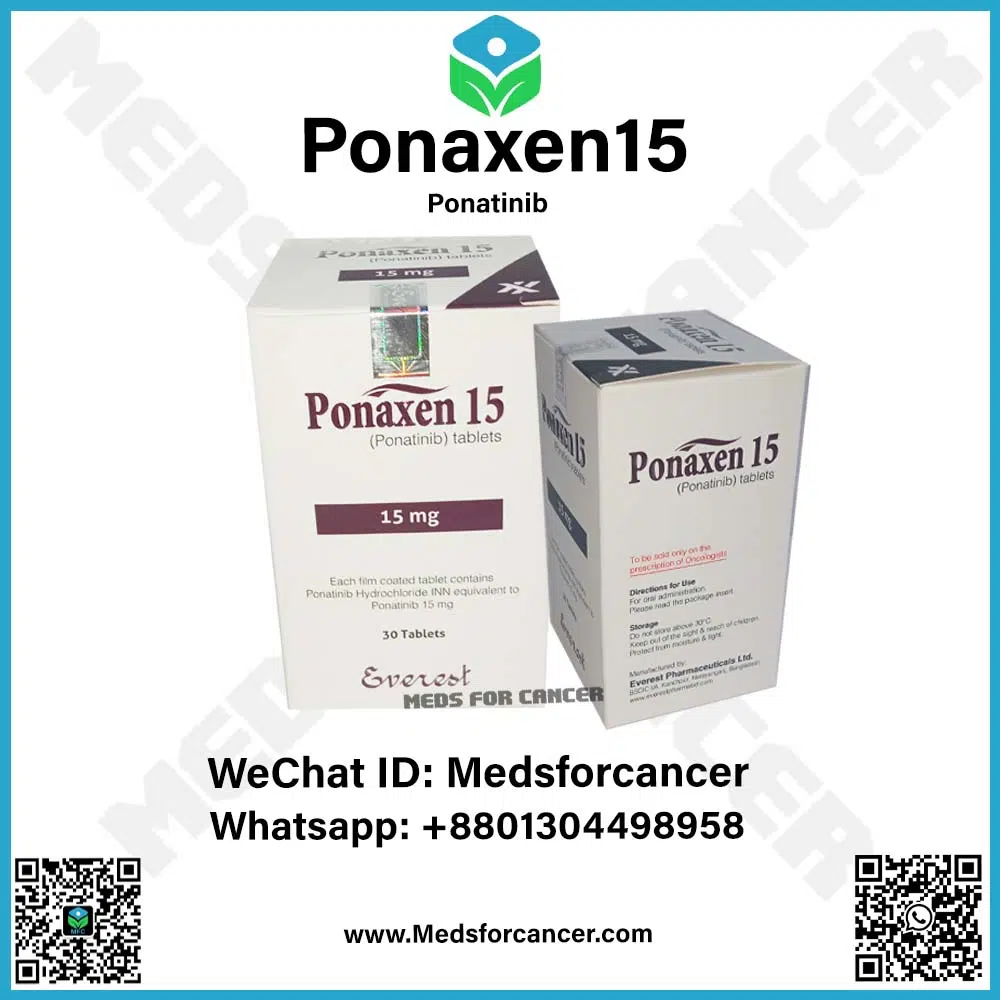
Ponaxen is a generic formulation of Ponatinib — a third-generation, multi-targeted tyrosine kinase inhibitor — manufactured by Everest Pharmaceuticals Ltd. under WHO-GMP certified conditions in Bangladesh. Available in 15 mg and 45 mg strengths, Ponaxen contains the same active molecule found in Iclusig® (Takeda), and is dispensed under the Named Patient Program.
Ponatinib’s defining clinical feature is its activity against the T315I mutation — a specific BCR-ABL mutation that makes CML and Ph+ ALL resistant to other tyrosine kinase inhibitors. This is why ponatinib is generally reserved for patients who have not responded to, or cannot tolerate, other TKIs.
| Generic name | Ponatinib (hydrochloride) |
| Reference brand | Iclusig® (Takeda) |
| Manufacturer | Everest Pharmaceuticals Ltd. |
| Standard | WHO-GMP Certified |
| Drug class | Multi-targeted TKI (BCR-ABL, including T315I) |
| Dosage form | Tablet — 15 mg and 45 mg strengths |
| Route | Oral · once daily, with or without food |
| Prescription | Required — haematologist/oncologist only |
How Ponatinib Works
CML and Ph+ ALL are driven by the BCR-ABL fusion protein, an abnormal tyrosine kinase that constantly signals white blood cells to multiply uncontrollably. Most TKIs block this protein effectively — but a specific mutation, T315I, changes the protein’s shape enough to block most TKIs from binding.
Ponatinib was specifically engineered to maintain binding activity even against the T315I mutation, making it effective in patients whose disease has become resistant to other kinase inhibitors like imatinib, dasatinib, and nilotinib.
Dosing & Adjustments
Standard starting dose: 45 mg once daily. Dose reductions are common and expected during treatment based on response and tolerability.
| Hepatic impairment (Child-Pugh A/B/C) | Start at 30 mg once daily |
| Taking strong CYP3A inhibitors | Reduce to 30 mg once daily |
| First dose reduction (for toxicity) | 30 mg once daily |
| Second dose reduction | 15 mg once daily |
| Third dose reduction | 10 mg once daily |
| Unable to tolerate 10 mg/day | Permanently discontinue |
Monitoring Requirements
- Complete blood count weekly for the first 2 months, then monthly thereafter
- Liver function tests monthly for the first 3 months, then at least every 3 months
- Blood pressure and cardiovascular risk factor monitoring throughout treatment
- Prompt evaluation of any symptoms suggesting arterial occlusion (chest pain, numbness/weakness, vision changes, leg pain when walking)
Side Effects
Common · Usually Manageable
- Skin rash, dry skin
- Joint and muscle pain
- Abdominal pain
- Headache
- Constipation
- Fatigue
- Hypertension
Serious · Report Immediately
- Arterial occlusion (heart attack, stroke, vision loss)
- Venous thromboembolism (DVT, pulmonary embolism)
- Heart failure
- Liver damage
- Pancreatitis
- Chest pain, sudden weakness, numbness, difficulty speaking, or vision loss (possible arterial occlusion or stroke)
- Sudden leg swelling or pain, or breathlessness (possible blood clot)
- Severe abdominal pain (possible pancreatitis)
How to Take Ponaxen
- 1Once daily, same time each day — with or without food.
- 2Swallow tablet whole with a full glass of water. Do not crush or chew.
- 3If you miss a dose, do not take it late or double up — skip it and resume your normal schedule the next day.
- 4Attend every scheduled cardiovascular check — given the arterial occlusion risk, this monitoring is a mandatory part of safe treatment, not optional.
- 5Storage: 15–30°C, dry place, away from direct sunlight, out of reach of children.
Frequently Asked Questions
Why does Ponaxen carry a boxed warning?
Why is Ponaxen only used after other TKIs have failed?
What is the T315I mutation?
How do I order Ponaxen through Meds For Cancer?
Meds For Cancer operates as a Named Patient Program (NPP) facilitator. WHO-GMP certified medicines are made available to individual patients with a confirmed medical need and a valid prescription, in countries where the branded product is unavailable or unaffordable.
- Cortes JE, et al. Ponatinib in refractory Philadelphia chromosome-positive leukemias (PACE trial). NEJM 2013;369:1783–1796.
- FDA Prescribing Information: Iclusig (ponatinib), including Boxed Warning. Takeda, 2023.