Description
Is Niranib 100 mg right for your situation?
Review these criteria with your oncologist before enquiring- ✓Recurrent epithelial ovarian, fallopian tube, or primary peritoneal cancer in response to platinum-based chemotherapy
- ✓Need a maintenance therapy started within 8 weeks of your most recent platinum-containing regimen
- ✓Need a WHO-GMP generic alternative to Zejula® (GSK)
- ✓Hold a valid oncologist prescription
- ✗Disease has not responded to platinum-based chemotherapy
- ✗Pre-existing myelodysplastic syndrome (MDS) or acute myeloid leukaemia (AML)
- ✗Pregnant, planning pregnancy, or breastfeeding
- ✗Severe pre-existing hypertension without medical management
Check Availability & Pricing
Prescription required · Named Patient Program · Worldwide shipping
🛡 WHO-GMP Certified · Prescription verified · Express dispatch
What is Niranib 100 mg?
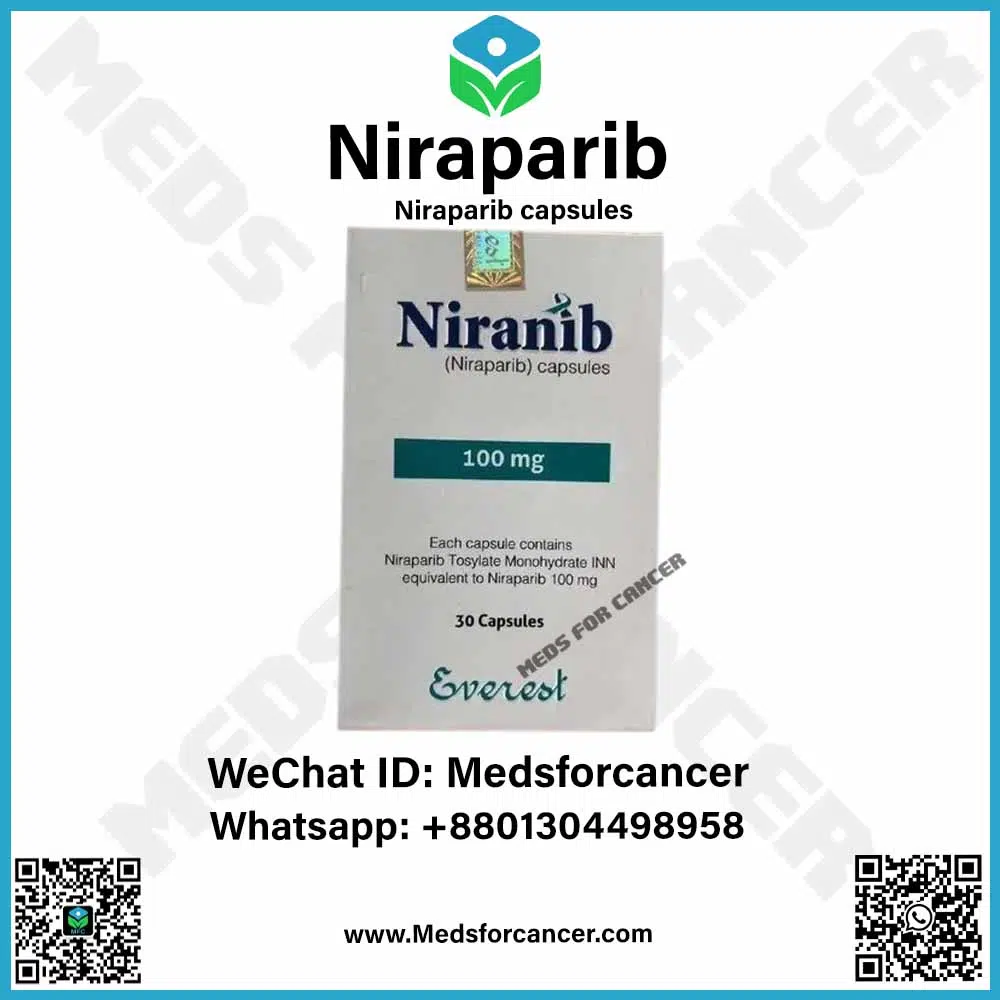
Niranib 100 mg is a generic formulation of Niraparib — a PARP (Poly ADP-ribose Polymerase) inhibitor — manufactured by Everest Pharmaceuticals Ltd. under WHO-GMP certified conditions in Bangladesh. Each capsule contains 100 mg of niraparib tosylate monohydrate, the same active molecule found in Zejula® (GSK), and is dispensed under the Named Patient Program for patients requiring an affordable, quality-assured alternative.
Unlike olaparib, niraparib is approved for maintenance therapy regardless of BRCA mutation status — making it usable across a broader patient population, including those without a BRCA mutation.
| Generic name | Niraparib |
| Reference brand | Zejula® (GSK) |
| Manufacturer | Everest Pharmaceuticals Ltd. |
| Standard | WHO-GMP Certified |
| Drug class | PARP Inhibitor |
| Dosage form | Capsule — 100 mg |
| Pack size | 30 capsules per pack |
| Route | Oral · once daily |
| Prescription | Required — oncologist only |
How Niraparib Works
PARP enzymes help cells repair single-strand DNA breaks. Cancer cells — particularly those with HRR deficiency such as BRCA mutations — rely on PARP as a critical backup repair pathway. Niraparib inhibits PARP1 and PARP2, preventing this repair and causing the accumulation of DNA damage that ultimately leads to cancer cell death.
What to Expect: First 30 Days
Niraparib has a distinct early side-effect profile compared to other PARP inhibitors — blood pressure and platelet monitoring are especially important in the first month.
- Week 1: Nausea and fatigue are the most common early symptoms. Taking the dose at bedtime is often recommended specifically to help manage nausea.
- Weeks 2–3: Weekly blood counts begin — particularly platelet counts, which can drop more significantly with niraparib than with other PARP inhibitors. Blood pressure monitoring also begins during this window.
- Week 4: Weekly blood monitoring continues through the first month, transitioning to monthly checks for the remainder of the first year if counts remain stable.
Side Effects
Niraparib’s side-effect profile includes more pronounced platelet and blood pressure effects compared to other PARP inhibitors, requiring closer early monitoring.
Common · Usually Manageable
- Nausea and vomiting
- Fatigue
- Constipation
- Decreased appetite
- Headache
- Insomnia
- Dry mouth or altered taste
Serious · Report Immediately
- Thrombocytopenia (low platelet count)
- Myelodysplastic syndrome (MDS) / acute myeloid leukaemia (AML)
- Severe hypertension or hypertensive crisis
- Pneumonitis (lung inflammation)
- Posterior reversible encephalopathy syndrome (PRES) — rare
- Unusual bruising, bleeding gums, or blood in stool or urine (possible low platelets)
- Severe headache, confusion, or vision changes (possible severe hypertension or PRES)
- New or worsening breathlessness, dry cough, or fever
How to Take Niranib 100 mg
Standard dose: 300 mg (three 100 mg capsules) once daily, with or without food. Some patients with lower body weight or platelet counts may start at a reduced dose — follow your oncologist’s specific prescription.
- 1Once daily, at approximately the same time each day — not twice daily. Bedtime dosing can help manage nausea.
- 2Swallow capsules whole with water. Do not chew or crush.
- 3If you vomit or miss a dose, do not take an additional dose — resume at your next scheduled time.
- 4Monitor blood pressure regularly as advised by your oncologist — niraparib can cause hypertension.
- 5Storage: below 30°C, protected from moisture, light, and out of reach of children. Do not use if exposed to temperatures above 40°C.
Caregiver Guidance
- ♥Watch for bleeding or bruising — niraparib can cause significant platelet drops. Unusual bruising, bleeding gums, or blood in urine/stool should be reported promptly.
- ♥Track weekly blood pressure and blood counts — especially during the first month, when monitoring is most frequent.
- ♥Confirm once-daily dosing — niraparib is taken once a day, not twice. Help establish a consistent bedtime routine to support adherence and manage nausea.
If the Medicine Stops Working
Frequently Asked Questions
Do I need a BRCA test before starting Niranib?
Is Niranib taken once or twice daily?
Why is blood pressure monitoring important with Niranib?
How soon after chemotherapy should I start Niranib?
What blood monitoring will I need?
How do I order Niranib through Meds For Cancer?
Meds For Cancer operates as a Named Patient Program (NPP) facilitator. Under this framework, WHO-GMP certified medicines are made available to individual patients with a confirmed medical need and a valid oncologist prescription, in countries where the branded product is unavailable or unaffordable.
This service does not constitute retail pharmacy dispensing. A prescription review is mandatory before any order is processed.
- Gonzalez-Martin A, et al. Niraparib in patients with newly diagnosed advanced ovarian cancer (PRIMA). NEJM 2019;381:2391–2402.
- Mirza MR, et al. Niraparib maintenance therapy in platinum-sensitive recurrent ovarian cancer (NOVA). NEJM 2016;375:2154–2164.
- NCCN Clinical Practice Guidelines in Oncology: Ovarian Cancer. V3.2026.
- Moore KN, et al. Niraparib monotherapy for late-line treatment of ovarian cancer (QUADRA). Lancet Oncol 2019;20:636–648.