Description
Is Laronib 100 mg right for your situation?
Review these criteria with your oncologist before enquiring- ✓Genomic testing (e.g. NGS) confirms your tumor carries an NTRK gene fusion, with no known acquired resistance mutation
- ✓Your solid tumor is metastatic, or surgical resection would likely cause severe morbidity
- ✓No satisfactory alternative treatment exists, or your cancer progressed on prior therapy
- ✓Seeking a WHO-GMP certified generic Larotrectinib by Everest Pharmaceuticals
- ✗Genomic testing shows your tumor does not have an NTRK gene fusion
- ✗Pregnant or breastfeeding — can cause fetal harm
- ✗Severe hepatic impairment or uncontrolled cardiac arrhythmia
- ✗On strong CYP3A4 inhibitors or inducers without dose review
Check Availability & Pricing
Prescription required · Named Patient Program · Worldwide shipping
🛡 WHO-GMP Certified · Prescription verified · Express dispatch
What is Laronib 100 mg?
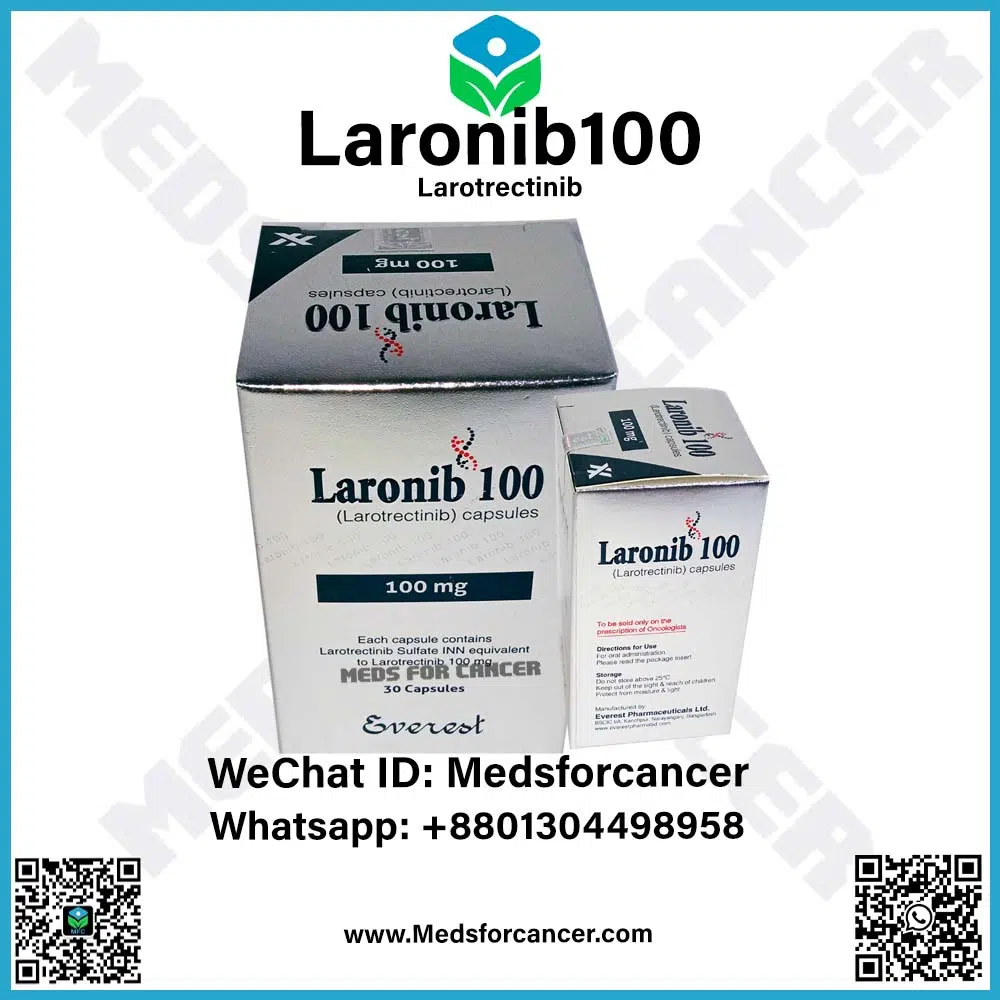
Laronib 100 mg is a generic capsule formulation of Larotrectinib (as larotrectinib sulfate) — a selective tropomyosin receptor kinase (TRK) inhibitor — manufactured by Everest Pharmaceuticals Ltd. under WHO-GMP certified conditions in Bangladesh. Each capsule contains 100 mg of larotrectinib, the same active molecule as in Vitrakvi® (Bayer), and is dispensed under the Named Patient Program.
Larotrectinib is a tumor-agnostic therapy — it is approved based on the presence of an NTRK gene fusion rather than the tumor’s tissue of origin, and has shown activity across tumor types including soft tissue sarcoma, salivary gland cancer, infantile fibrosarcoma, thyroid cancer, and lung cancer.
| Generic name | Larotrectinib (as larotrectinib sulfate) |
| Reference brand | Vitrakvi® (Bayer) |
| Manufacturer | Everest Pharmaceuticals Ltd. |
| Standard | WHO-GMP Certified |
| Drug class | Tropomyosin Receptor Kinase (TRK) Inhibitor |
| Dosage form | Capsule — 100 mg (also available 25 mg) |
| Pack size | 30 capsules per bottle |
| Route | Oral · twice daily, with or without food |
| Prescription | Required — oncologist only |
How Larotrectinib Works
NTRK genes can abnormally fuse with other genes, producing a constitutively active TRK fusion protein that drives tumour growth regardless of where in the body the cancer originated.
What to Expect: First 30 Days
Neurologic and gastrointestinal adjustment effects are most common early in treatment — most occur within the first three months.
- Before starting: baseline neurological exam and liver function tests are required.
- Week 1: Fatigue, mild dizziness, or an upset stomach are common as your body adjusts to the TRK inhibitor.
- Weeks 2–3: Side effects often become more predictable. Routine blood work monitors liver enzymes (AST/ALT).
- Week 4: Many patients establish a stable routine. Your care team continues assessing neurological response and liver function to confirm the dose is well tolerated.
Side Effects
Neurologic adverse reactions occur in about half of patients — most are mild, but should always be reported promptly.
Common · Usually Manageable
- Fatigue and weakness
- Nausea and vomiting
- Mild dizziness or cough
- Constipation or diarrhoea
Serious · Report Immediately
- Elevated liver enzymes (hepatotoxicity)
- Neurologic complications: ataxia, gait disturbance, confusion
- Severe (Grade 3–4) neurotoxicity occurs in roughly 6–7% of patients
- Severe dizziness, loss of balance, confusion, or difficulty speaking
- Yellowing of skin/eyes, dark urine, or severe abdominal pain
How to Take Laronib 100 mg
Standard adult dose: 100 mg twice daily, with or without food, until disease progression or unacceptable toxicity. Pediatric patients with body surface area under 1.0 m² are dosed differently (100 mg/m² twice daily) — follow your oncologist’s exact prescription.
- 1Swallow whole with a full glass of water. Do not chew, crush, or open — the contents are highly bitter and must remain intact to absorb correctly.
- 2With or without food, same times each day for consistent levels.
- 3If you miss a dose, take it as soon as remembered unless the next dose is due within 6 hours — never double up.
- 4Never stop or adjust without medical guidance — for Grade 3/4 side effects, your oncologist may withhold and resume at a reduced dose, or discontinue permanently if the reaction doesn’t resolve within 4 weeks.
Caregiver Guidance
- ♥Watch balance, gait, and speech — neurological side effects must be reported to the treating team promptly.
- ♥Keep a daily symptom log, particularly noting nausea, fatigue, or any coordination changes.
- ♥Ensure all scheduled blood tests are attended — liver function monitoring is a routine part of care on this medicine.
If Resistance Develops
Frequently Asked Questions
Do I need biomarker testing before starting Laronib?
How does Laronib compare to Vitrakvi®?
Can I take it with my other daily medicines?
How do I order Laronib through Meds For Cancer?
Meds For Cancer operates as a Named Patient Program (NPP) facilitator. Under this framework, WHO-GMP certified medicines are made available to individual patients with a confirmed medical need and a valid oncologist prescription, in countries where the branded product is unavailable or unaffordable.
This service does not constitute retail pharmacy dispensing. A prescription review is mandatory before any order is processed.
- Drilon A, et al. Efficacy of larotrectinib in TRK fusion-positive cancers. NEJM 2018;378:731–739.
- Hong DS, et al. Larotrectinib in adult and pediatric TRK fusion cancers (pooled analysis). Lancet Oncol 2020;21:531–540.
- FDA Prescribing Information: Vitrakvi (larotrectinib). Bayer, 2018.